🌱 Echeveria elegans
🧾 Quick Facts
Echeveria elegans, commonly known as the Mexican Snowball, is a popular succulent among houseplant enthusiasts due to its attractive rosette shape and low maintenance requirements.
- Common names: Mexican Snowball, Mexican Gem
- Scientific name: Echeveria elegans
- Plant type: Succulent
- Growth habit: Rosette
- Typical indoor size range: 4-8 inches in height and spread
- Growth speed: Moderate
- Lifespan: Can live many years with proper care
- Origin: Native to Mexico
- Light preference: Bright indirect sunlight
- Water needs: Low, prefers to dry out between waterings
- Temperature & humidity preference: Warm temperatures, low humidity
- Pet safety: Generally considered non-toxic to pets
- Difficulty: Easy
🔍 Identification & Look-Alikes
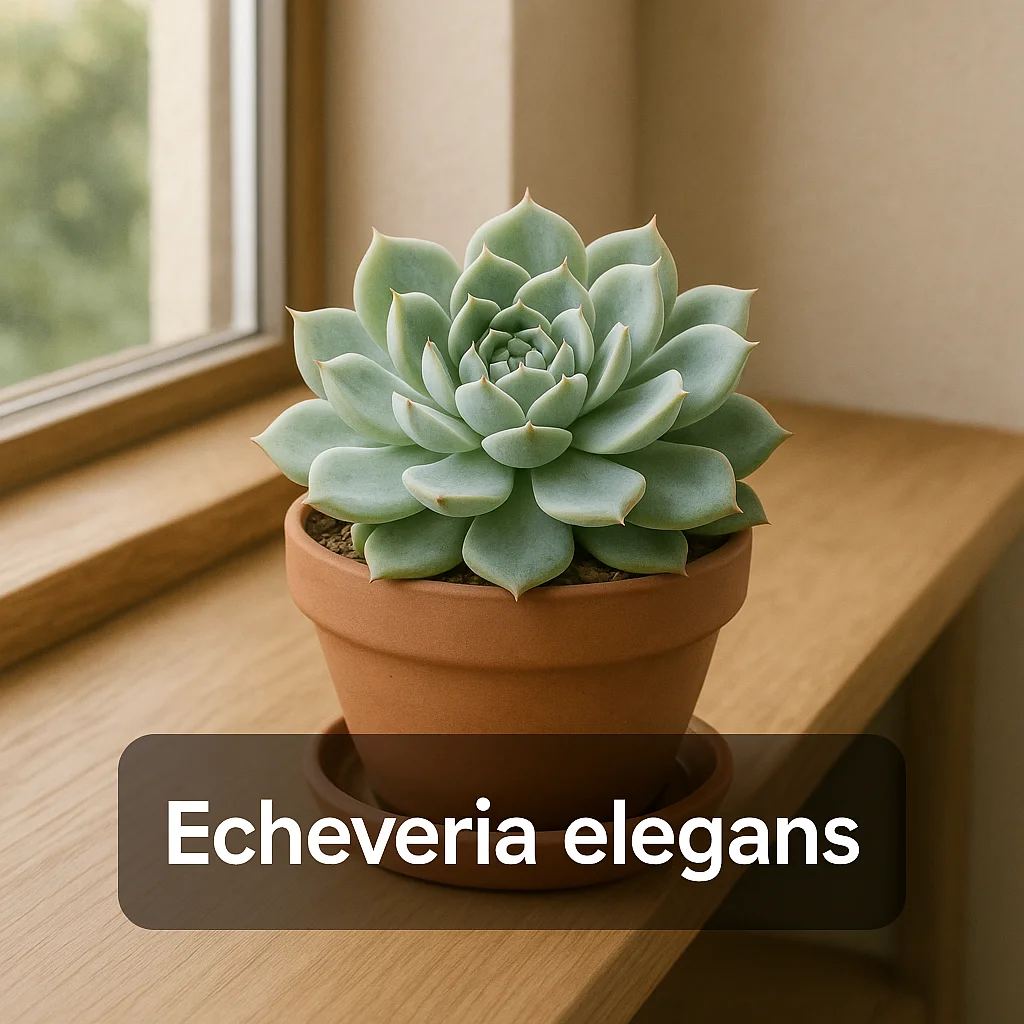
Echeveria elegans is characterized by its symmetrical rosette of thick, succulent leaves which are bluish-green with a hint of pink on the edges. The leaves are spoon-shaped and have a powdery coating giving them a soft look. This plant rarely grows a visible stem, maintaining its rosette shape close to the soil surface.
Echeveria elegans can occasionally be mistaken for other Echeveria species or rosette-forming succulents like Sempervivum but can be distinguished by its characteristic powdery coating and specific color gradient.
- Leaves form a tight rosette, typically symmetrical.
- Bluish-green leaves with pinkish edges.
- Leaves have a matte, powdery finish.
- Typically stemless, grows low to the ground.
- Flowers are bell-shaped, pinkish-red with yellow tips.
- Blooms occasionally indoors with sufficient sunlight.
- Look-alikes include Echeveria 'Lola' and Sempervivum species.
- Distinguish by leaf touch and flower color/shape.
- Needs bright, indirect light for best form and coloration.
🌍 Origin & Natural Habitat
Native to the semi-desert regions of Mexico, Echeveria elegans thrives in rocky, sunny environments. It is well-adapted to arid conditions, often growing on sandy, well-draining soils in areas with infrequent rainfall.
Understanding its natural habitat helps guide indoor care, as it implies a need for plenty of sunlight and a potting mix that replicates its well-drained, aerated natural soils, ensuring root health and minimizing rot risk.
☀️ Light Requirements
Echeveria elegans performs best in bright, indirect light. Ideal placements include south or east-facing windows where the plant can receive abundant light without the harshness of direct midday sun. Too little light can lead to leggy growth, while excessive direct sunlight might cause sunburn.
- Place near a bright window with access to indirect light.
- East or south-facing windows are often ideal.
- Avoid prolonged periods of harsh, direct sun.
- Signs of too little light include elongated, stretched stems.
- Yellowing leaves can indicate too much direct sun.
- Rotate the plant occasionally to promote even growth.
- Supplement with a grow light if necessary.
- Dust off leaves regularly to maximize light absorption.
- Monitor for any color fading or bleaching spots on leaves.
💧 Watering & Humidity
Echeveria elegans requires a "soak and dry" watering method: thoroughly water the soil until it is completely wet and then allow it to dry out before the next watering. This succulent prefers low humidity, tolerating typical indoor dryness but suffers in overly damp conditions.
- Water only when the soil is completely dry.
- Use well-draining pots to allow excess water out.
- Increase watering frequency during summer (growing season).
- Reduce watering in winter (dormancy period).
- Pot size affects drying rate—adjust frequency accordingly.
- Signs of overwatering include mushy, translucent leaves.
- Underwatering may cause shriveled or crispy leaves.
- Maintain humidity levels by avoiding misting.
- If indoors, maintain average home humidity.
🐛 Soil, Pot & Repotting
The ideal soil for Echeveria elegans is a well-draining cactus mix, which can be custom-made by mixing standard potting soil with sand or perlite. When selecting a pot, opt for terracotta or clay with drainage holes for natural moisture control. Repotting is typically only necessary every few years or when the plant becomes rootbound.
- Use gritty, well-draining cactus or succulent soil.
- Include components like perlite or sand for drainage.
- Pot with drainage holes is essential to prevent water buildup.
- Terracotta pots encourage better aeration for roots.
- Repot when roots appear through drainage holes.
- Choose a pot only one size larger when repotting.
- Avoid overpotting, as this can lead to wet roots.
- Repot gently to minimize shock or root damage.
- Refresh old soil by gently shaking out the root ball.
🌡️ Temperature, Airflow & Seasonal Care
Echeveria elegans thrives in warm, seasonal indoor environments, preferring temperatures between 65°F and 80°F. It benefits from gentle airflow but should be kept away from cold drafts or heat sources such as radiators. In winter, reduced watering and cooler temperatures are appropriate as the plant enters a dormant period.
- Ideal temperatures are 65°F to 80°F.
- Avoid exposure to freezing temperatures.
- Protect from drafts and sudden temperature changes.
- Adequate airflow helps prevent fungal issues.
- Reduce watering frequency in cooler months.
- Expect slowed growth during winter dormancy.
- Gradually reintroduce to increased light and watering in spring.
🌸 Flowers, Fruit & Growth Cycle
Echeveria elegans may produce flower stalks featuring bell-shaped pinkish-red flowers in optimal indoor conditions, typically during spring or summer. Its growth cycle includes a growing season of increased leaf production and a dormant winter where growth slows. Regular pruning is minimal, involving removal of dead leaves to maintain plant health.
🧬 Propagation & Reproduction
Echeveria elegans can easily be propagated through leaf cuttings or offsets. Offsets, or 'pups', are the most straightforward method: carefully remove and replant them to grow new plants. Leaf propagation involves selecting a healthy leaf, letting it callus, and placing it on a suitable substrate until roots and new rosettes form.
- Offsets form naturally at the base of the rosette.
- Gently twist off offsets for individual planting.
- Let leaf cuttings callus before planting.
- Place callused leaves on soil for roots to develop.
- Monitor for signs of rot in damp conditions.
🌿 Common Problems, Pests & Prevention
Common issues for Echeveria elegans include yellowing leaves from overwatering, brown tips due to underwatering, or leggy growth from insufficient light. Pests such as mealybugs, spider mites, and scale can be problematic if care conditions are not stable.
- To prevent issues, maintain stable conditions.
- Ensure proper light and watering balance.
- Inspect and clean leaves periodically to avoid pests.
- Isolate new plants to prevent pest introduction.
- Avoid letting excess water stand in saucers.
- Encourage airflow around plant foliage.
- Discontinue watering if any rot or mold appears.
- Address pest problems early with safe, physical removal.
🐾 Pet & Home Safety Notes
Generally, Echeveria elegans is considered non-toxic to pets and humans. However, it is wise to place plants out of reach to discourage accidental ingestion or damage. If accidental consumption occurs, contacting a professional or local poison control resources is advisable.
🏡 Styling Ideas & Best Room Placement
Echeveria elegans is a versatile plant choice for various interior styles, perfectly suited for windowsills, bright kitchens, or bathrooms. Its compact size makes it excellent for creating succulent arrangements or fitting spaces without competing for attention. Pairing with contrasting-leafed succulents can highlight its unique rosette form.
📌 Summary
- Echeveria elegans features bluish-green, rosette-forming leaves.
- Native to the arid regions of Mexico, appreciates sunny locales.
- Requires bright, indirect light, susceptible to leggy growth in low light.
- Practice "soak and dry" watering to keep the succulent healthy.
- Thrives in well-drained, gritty soil; terracotta or porous pots work best.
- Optimal indoors temperature is between 65°F and 80°F.
- Propagate through offsets or leaf cuttings for new growth.
- Common pests include mealybugs & spider mites; maintain stable care.
- Non-toxic but advisable to keep out of reach of pets/children.
- Works well in small arrangements; showcase in brightly lit spaces.