🌱 Calathea ‘White Fusion’ (Goeppertia lietzei)
🧾 Quick Facts
Calathea ‘White Fusion’, also known by its scientific name Goeppertia lietzei, is a vibrant and popular houseplant admired for its stunning variegated foliage. This plant is particularly noted for its intricate white patterns contrasted against lush green, making it highly sought after among plant enthusiasts. Below are some essential quick facts about this attractive houseplant:
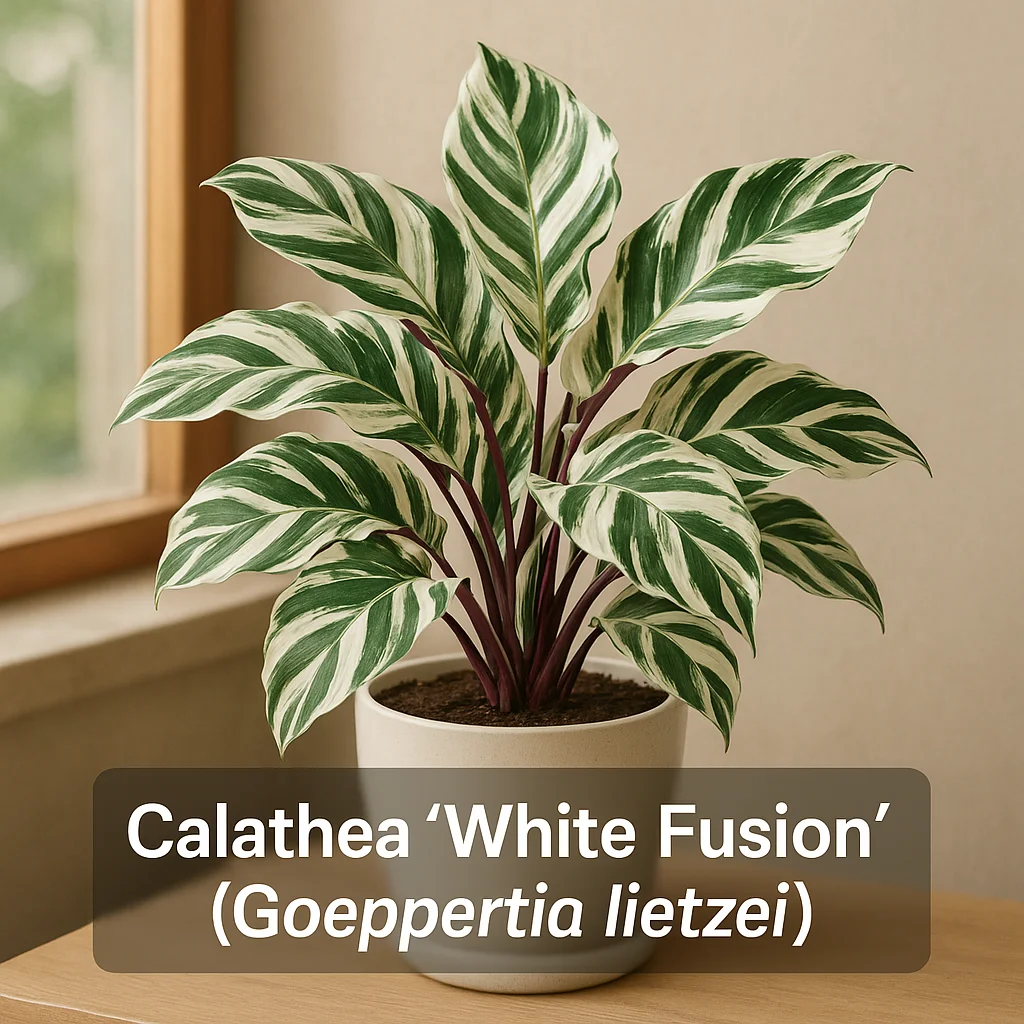
- Common names: Calathea ‘White Fusion’
- Scientific name: Goeppertia lietzei
- Plant type: Foliage
- Growth habit: Upright
- Typical indoor size range: 1-2 feet tall and wide
- Growth speed: Slow to moderate
- Lifespan: Can live many years with proper care
- Origin: Native to the tropical regions of South America
- Light preference: Bright indirect light
- Water needs: Moderate, prefers to remain moist but not soggy
- Temperature & humidity preference: Warm, humid environments
- Pet safety: May be irritating to pets
- Difficulty: Medium
🔍 Identification & Look-Alikes
Calathea ‘White Fusion’ is celebrated for its ornately patterned leaves, which feature creamy white and green variegation with hints of purple undersides. The leaves are elliptical, occasionally oval, with a smooth texture and emerge from slender stems. Over time, this plant forms a bushy clump. It is primarily grown for its foliage, as it rarely flowers indoors.
Often mistaken for other Calathea varieties due to similar variegation patterns, it can be distinguished by its unique white marbling which provides a striking contrast against dark green. It is essential to provide adequate indirect light to maintain these patterns, or else the colors may fade.
- ✦ Elliptical leaves with white and green variegation
- ✦ Purple underside of leaves
- ✦ Slender, upright stems
- ✦ Forms bushy clusters
- ✦ Leaf patterns fade in low light
- ✦ Rarely flowers indoors
- ✦ Often confused with other Calathea, but more white in patterns
- ✦ Leaf texture is smooth and non-hairy
- ✦ Stems are relatively short, supporting clustered leaves
🌍 Origin & Natural Habitat
Calathea ‘White Fusion’ hails from the rich and diverse tropical regions of South America, where it thrives under the deep canopy of rainforests. This natural habitat is characterized by high humidity, dappled light, and warm temperatures, which sheds light on its care requirements indoors.
Understanding this origin is crucial for houseplant enthusiasts, as it informs the need for maintaining similar conditions within homes. High humidity, warm temperatures, and avoiding direct sunlight are vital to mimic the plant’s natural environment.
☀️ Light Requirements
For optimal growth, place Calathea ‘White Fusion’ where it receives bright, indirect light. Direct sunlight can scorch its leaves, while too little light will reduce its vibrant variegation. In indoor settings, placing this plant away from direct southern exposure, yet near a bright window, is ideal.
Bright indirect light can be achieved with diffused lighting, such as a sheer curtain. Signs of insufficient light include leggy growth and faded leaf patterns, whereas too much light can cause leaf burn.
- ✦ Avoid direct sunlight to prevent leaf burn
- ✦ Place near north or east-facing windows
- ✦ Use curtains to diffuse harsh sunlight
- ✦ Maintain consistent light exposure daily
- ✦ Rotate plant regularly for even growth
- ✦ Adjust position if variegation fades
- ✦ Supplement with artificial light if needed
- ✦ Observe leaf color changes as light indicator
- ✦ Ensure at least bright, filtered light exposure
💧 Watering & Humidity
Calathea ‘White Fusion’ thrives in consistently moist soil but is sensitive to overwatering. A good watering rhythm involves soaking the soil thoroughly and allowing the top inch to dry out before watering again. During the growing season, more frequent watering may be needed.
Humidity is crucial; aiming for higher than average room humidity will keep leaves lush. Consider using a humidifier or grouping with other plants. Yellowing leaves and droopy foliage can indicate overwatering, while crispy brown edges suggest low humidity.
- ✦ Allow top inch of soil to dry before watering
- ✦ Increase humidity with trays or humidifiers
- ✦ Adjust watering frequency as seasons change
- ✦ Observe plant for droop or browning tips
- ✦ Use room temperature water to prevent shock
- ✦ Ensure pot has drainage holes to prevent soggy roots
- ✦ Watch for yellowing as an overwatering sign
- ✦ Maintain soil moisture balance without waterlogging
- ✦ Group with other plants to create a humid microclimate
- ✦ Mist leaves occasionally, avoiding drenching the soil
🐛 Soil, Pot & Repotting
A well-draining, airy potting mix is essential for Calathea ‘White Fusion’. Consider using a peat-based mix combined with perlite to enhance drainage while retaining moisture. Pots should have ample drainage holes to prevent waterlogging.
Repotting is generally needed every two years or when the plant becomes rootbound, indicated by roots protruding from drainage holes or stunted growth. Opt for a pot one size larger and repot in spring for best results.
- ✦ Use well-draining, airy potting mix
- ✦ Ensure pot has drainage holes
- ✦ Choose slightly larger pot when repotting
- ✦ Repot every 1-2 years or when rootbound
- ✦ Perform repotting during active growth seasons
- ✦ Monitor for roots emerging from pot bottom
- ✦ Handle roots gently during repotting process
- ✦ Use fresh soil to encourage healthy growth
- ✦ Avoid repotting in extreme weather conditions
- ✦ Match new pot material to environment (terracotta/plastic)
🌡️ Temperature, Airflow & Seasonal Care
Calathea ‘White Fusion’ thrives in temperatures ranging from 65°F to 80°F. It is sensitive to drafts, extreme temperature changes, and air conditioning vents. Keeping a stable, warm environment is vital to maintaining its health.
As seasons change, its growth slows during cooler months, and watering frequency should be adjusted. Avoid placing it near heaters or cold windows, and ensure gentle airflow around the plant to prevent stagnant conditions.
- ✦ Maintain a temperature range of 65°F to 80°F
- ✦ Avoid placing near cold drafts or heat sources
- ✦ Reduce watering in winter due to slower growth
- ✦ Ensure good but gentle air circulation
- ✦ Protect from sudden temperature swings
- ✦ Consider seasonal placement changes
- ✦ Use fans to enhance airflow gently if necessary
- ✦ Monitor plant response to environment changes
🌸 Flowers, Fruit & Growth Cycle
While Calathea ‘White Fusion’ is admired for its foliage, it rarely flowers indoors. In its natural habitat, it may produce small flowers close to the soil’s surface, but indoor blooming varies significantly. Growth primarily involves the development of new leaves, emerging as rolled tubes.
Pruning is not often necessary but can involve trimming back any brown or damaged leaves. Maintaining clean, sharp scissors and practicing hygiene can help prevent potential disease spread.
🧬 Propagation & Reproduction
Propagation of Calathea ‘White Fusion’ is mainly done through division. This method is more straightforward during repotting when the plant's rhizomes can be gently separated and potted individually. Other methods like stem cuttings are less common due to the plant’s structure.
- ✦ Divide during repotting for best success
- ✦ Handle rhizomes gently to avoid damage
- ✦ Ensure divisions have roots and leaves
- ✦ Use fresh potting mix for new divisions
- ✦ Provide same care standards as parent plant
- ✦ Propagation success varies based on plant health
- ✦ Monitor new growth carefully after division
🌿 Common Problems, Pests & Prevention
Yellow leaves, brown tips, and leaf droop in Calathea ‘White Fusion’ often indicate inconsistent watering or humidity. Spider mites and mealybugs are occasional pests that thrive in dry conditions, leading to speckled foliage and stunted growth.
Regularly cleaning leaves and maintaining stable environmental conditions can help prevent these issues. Quarantining new plants and ensuring clean tools mitigate pest spread and infestation risks.
- ✦ Observe regular leaf cleaning to deter pests
- ✦ Maintain consistent humidity and moisture levels
- ✦ Quarantine new plants as a precaution
- ✦ Inspect regularly for signs of pests like spider mites
- ✦ Avoid overcrowding to ensure airflow
- ✦ Rotate plant positions for even growth
- ✦ Remove visibly infested leaves promptly
- ✦ Utilize non-chemical methods for gentle pest control
🐾 Pet & Home Safety Notes
Calathea ‘White Fusion’ is generally considered safer for homes with pets, although some sources list it as potentially irritating. Plant placement out of reach on elevated stands or shelves can help prevent accidental ingestion.
If ingestion is suspected, contact a professional or local poison control resources for guidance. Training pets to avoid plant areas can also mitigate risks.
🏡 Styling Ideas & Best Room Placement
Owing to its need for higher humidity, Calathea ‘White Fusion’ is excellently suited for bathrooms and kitchens where moisture levels are naturally higher. Its striking appearance also makes it a centerpiece in living rooms or offices where light and humidity can be controlled.
Consider placing it in decorative pots on shelves or hanging baskets to enhance visual interest. Pairing with other tropical plants like Philodendrons or Pothos can create a lush, cohesive look.
📌 Summary
- ✦ Recognizable by its white and green variegated foliage
- ✦ Originates from tropical South American rainforests
- ✦ Prefers bright indirect light; avoid direct sun
- ✦ Requires consistent moisture; sensitive to overwatering
- ✦ Thrive in warm, humid environments; draft-sensitive
- ✦ Propagation mainly through division during repotting
- ✦ Common pests include spider mites and mealybugs
- ✦ Medium care level, may be irritating to pets
- ✦ Ideal for humid areas; versatile styling options