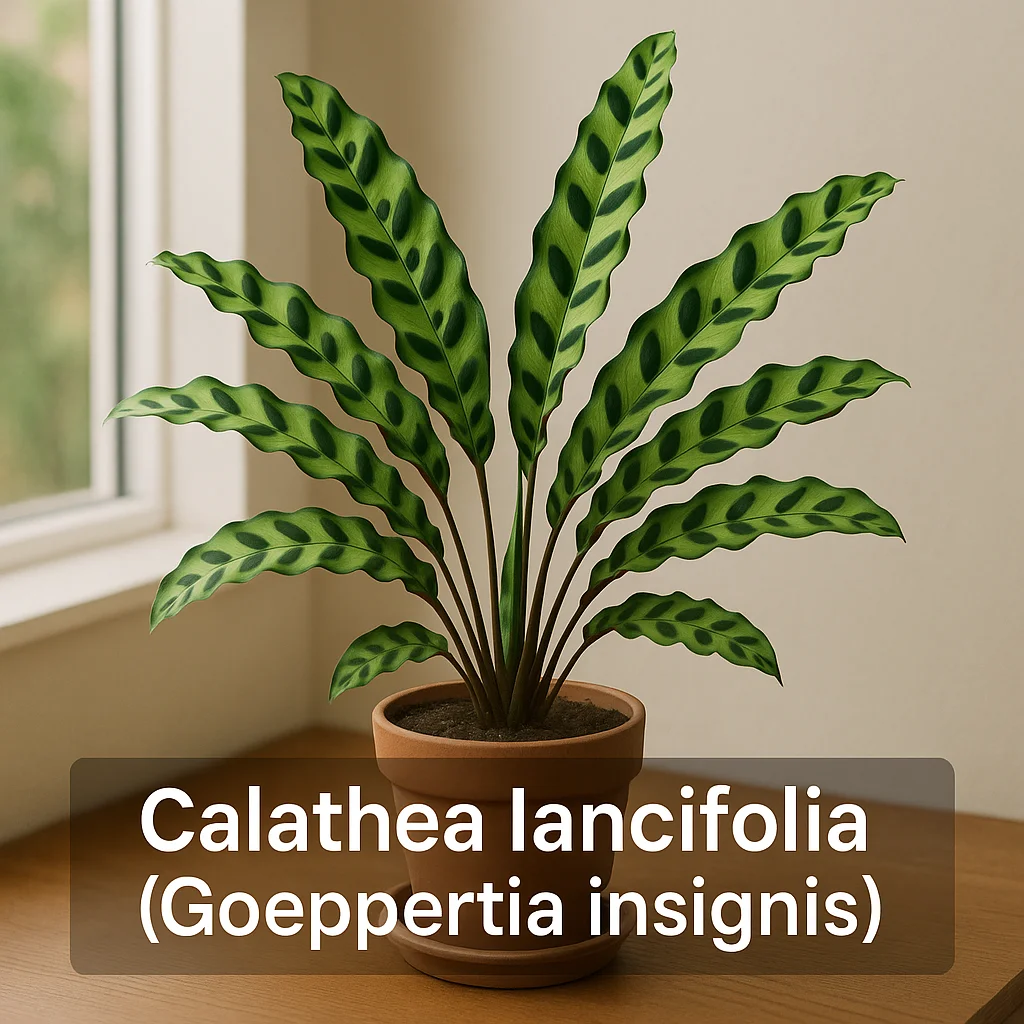
🌱 Calathea lancifolia (Goeppertia insignis)
🧾 Quick Facts
Calathea lancifolia, also known commonly as Rattlesnake Plant, is a popular houseplant admired for its striking foliage. Known for its vibrant patterns and textures, it's a resident of many indoor plant collections across the globe.
- Common names: Rattlesnake Plant, Calathea Rattlesnake
- Scientific name: Often sold as Calathea lancifolia, commonly listed under Goeppertia insignis
- Plant type: Foliage
- Growth habit: Upright
- Typical indoor size range: 1-2 feet tall and wide
- Growth speed: Moderate
- Lifespan: Can live many years with proper care
- Origin: Brazil, rainforest understory
- Light preference: Medium to bright indirect light
- Water needs: Moderate; prefers consistently moist soil
- Temperature & humidity preference: Warm temperatures and high humidity
- Pet safety: Some sources list it as mildly irritating to pets
- Difficulty: Medium
🔍 Identification & Look-Alikes
Calathea lancifolia is easily recognized by its long, narrow leaves with wavy edges and dark green spots that mimic a rattlesnake's skin. The leaves have a smooth texture and are arranged in an upright fashion, rising on thin, green stems. The underside of the leaves is a deep purple, adding to the plant's visual appeal.
It is grown mainly for its foliage, as it rarely blooms indoors. In rare instances, it may produce small, inconspicuous, white to yellow flowers.
Common look-alikes include other Calatheas and Marantas. To distinguish, focus on the unique leaf pattern and shape of Calathea lancifolia.
- Long, lance-shaped leaves
- Distinctive wavy leaf edges
- Dark green spots on lighter green background
- Purple undersides of leaves
- Smooth, slender stems
- Rare indoor blooming
- Compare with other Calatheas for varying leaf shapes
🌍 Origin & Natural Habitat
Native to the tropical rainforests of Brazil, Calathea lancifolia thrives in the forest understory where it receives filtered light through the canopy. This environment features consistent moisture, high humidity, and mild temperatures.
Understanding its natural habitat helps in replicating similar conditions indoors, ensuring the plant remains healthy. Providing filtered light, keeping the soil moist but not soggy, and maintaining high humidity can help replicate its natural environment.
☀️ Light Requirements
Calathea lancifolia prefers medium to bright indirect light, mimicking the dappled sunlight of rainforest understories. It can tolerate lower light levels, but variegation may fade without sufficient light. Avoid direct sunlight, which can scorch the leaves.
Signs of too little light include leggy growth and loss of coloration, while too much light may result in brown, crispy leaves.
- Position away from direct sunlight
- East or north-facing windows work well
- Bright indirect light promotes vibrant patterns
- Monitor for changes in leaf coloration
- Avoid direct southern exposure
- Rotate plant for even growth
- Use sheer curtains to diffuse light
💧 Watering & Humidity
Calathea lancifolia prefers a soak-and-drain watering method, allowing the soil to dry slightly between waterings. It's essential to use room-temperature water to avoid shocking the roots.
Increase watering frequency during warmer months and decrease during cooler ones. High humidity is crucial; aim for 50-60% humidity. Use humidifiers or pebble trays to maintain adequate levels. Overwatering may result in yellow leaves while underwatering often shows as crispy tips.
- Water when top inch of soil feels dry
- Use room-temperature water
- Increase humidity with a pebble tray
- Consider grouping plants for mutual humidity boost
- Monitor for yellowing leaves (overwatering sign)
- Address crispy tips by boosting humidity
- Adjust watering with seasonal changes
🐛 Soil, Pot & Repotting
Use a well-draining, moisture-retentive soil mix for Calathea lancifolia, such as a blend of regular potting soil with added peat moss and perlite. Select pots with drainage holes to prevent root rot.
Repotting is necessary every 1-2 years or when roots are visible through drainage holes. Choose a pot that is one size larger to prevent excessive soil that could retain moisture. Repot gently, loosening the root ball slightly before placing it into the new pot.
- Opt for a well-draining soil mix
- Select pots with drainage holes
- Repot every 1-2 years as needed
- Perform gentle root loosening during repotting
- Avoid drastically upsizing pots
- Water thoroughly after repotting
- Check for rootbound signs such as slowed growth
🌡️ Temperature, Airflow & Seasonal Care
Calathea lancifolia thrives in temperatures between 65-75°F (18-24°C). Protect the plant from cold drafts or sudden temperature changes which can cause stress.
During winter, growth may slow and watering needs decrease. Avoid placing it near heat sources or air vents. Maintain humidity throughout the year to prevent plant stress.
- Keep within 65-75°F (18-24°C)
- Avoid placing near AC vents or radiators
- Reduce watering in winter
- Maintain consistent humidity year-round
- Watch for signs of cold drafts
- Position away from frequent temperature changes
- Allow slow winter growth cycle
🌸 Flowers, Fruit & Growth Cycle
Although Calathea lancifolia can occasionally bloom indoors, it is primarily grown for its striking foliage. Its growth pattern involves producing new leaves from the center, unfurling new shoots as it matures.
Routine pruning is not typically required, but removing damaged leaves can maintain plant health. Regular leaf cleaning is beneficial for dust removal and ensuring optimal photosynthesis.
🧬 Propagation & Reproduction
Propagation is most successfully done via division during repotting. Separate sections of the root ball, ensuring each has sufficient roots and at least one stem.
Propagation through cuttings or seeds is challenging and uncommon for home growers due to the plant's growth habit and requirements.
- Propagate by division during repotting
- Ensure divisions have ample roots and stems
- Replant divisions in suitable potting mix
- Water newly planted divisions moderately
- Avoid propagation by cuttings due to difficulty
- Recognize seed propagation as rare in home conditions
🌿 Common Problems, Pests & Prevention
Calathea lancifolia may encounter issues such as yellow leaves, brown tips, or leaf drop. Pests like spider mites, mealybugs, and fungus gnats can occasionally be a problem.
Prevent issues by providing stable care, such as consistent watering, maintaining humidity, and ensuring good airflow. Clean leaves regularly to prevent dust build-up and check for pests periodically.
- Recognize yellow leaves as overwatering signs
- Address brown tips with increased humidity
- Regularly inspect for pests like spider mites
- Encourage stable moisture levels
- Clean leaves to prevent dust and pests
- Provide good air circulation around plants
- Quarantine new plants before introducing
🐾 Pet & Home Safety Notes
Some sources indicate that Calathea lancifolia may cause mild irritation if ingested by pets or children. Ensure safe placement out of reach, especially where pets or toddlers may access plants easily.
If ingestion is suspected, contact a professional or local poison control resources without delay.
🏡 Styling Ideas & Best Room Placement
A versatile plant, Calathea lancifolia benefits from placement in humid areas like bathrooms or kitchens, provided indirect light is available. It can also add vibrancy to living rooms and offices.
Consider using hanging baskets or floor pots to showcase its unique foliage. Pairs well with other humidity-loving plants such as ferns and prayer plants.
📌 Summary
- Recognizable by its wavy, lance-shaped, patterned leaves
- Originates from the rainforests of Brazil
- Prominent in medium to bright indirect light environments
- Consistent moisture and high humidity are key
- Well-draining soil and routine repotting sustain health
- Maintains optimal indoor temperature and consistent care
- Typically propagated through division
- Common issues include yellow leaves and pests like spider mites
- Consider medium difficulty level for care
- Pet-safe placement strategies are recommended for households